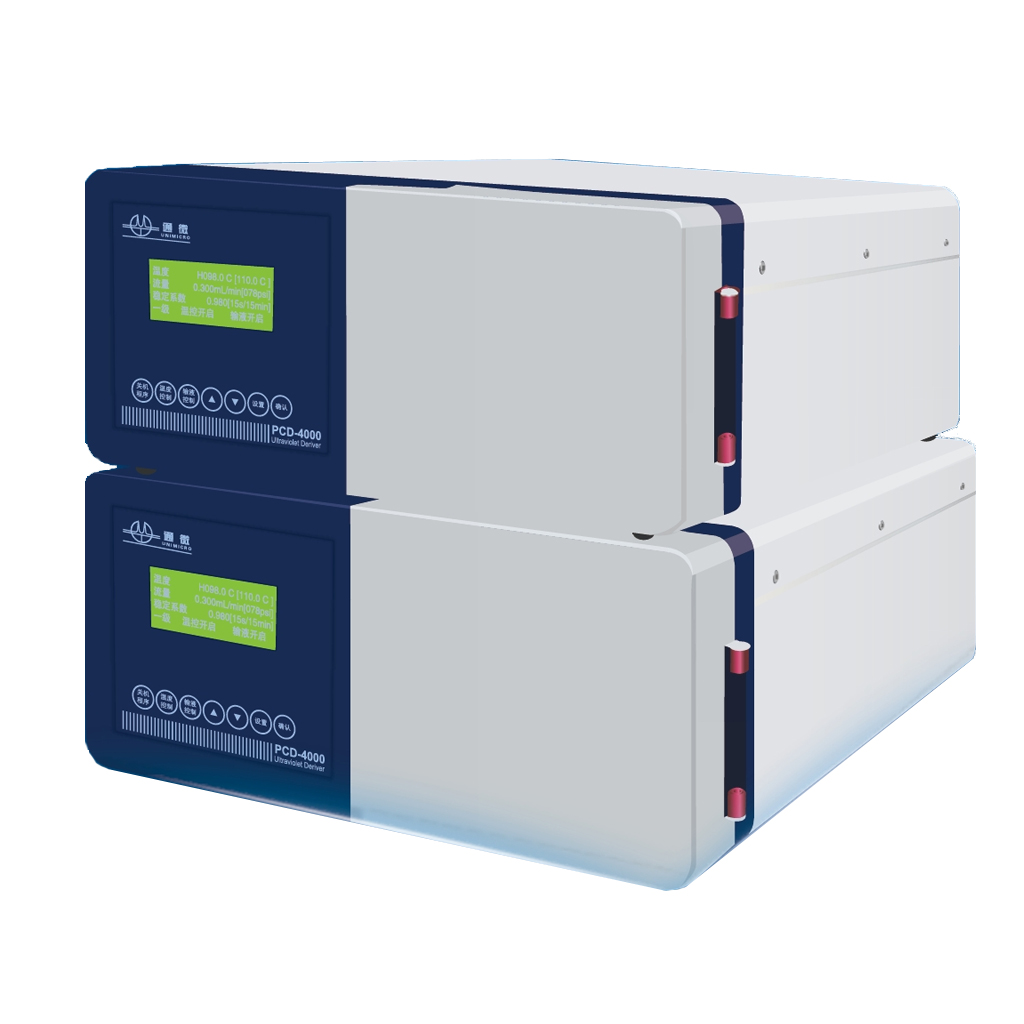
Instrument Introduction
The post-column derivatization system is used in liquid chromatography for the analysis of samples. First, the liquid chromatography column separates different components of the sample. Then, the separated components enter into a post-column derivatization reaction unit. Simultaneously, the pump delivering the derivatization reagent continuously supplies the reagent to the system, causing chemical or physical reactions between the sample components and the derivatization reagent, resulting in new chemical substances or physical states. The derivatized products then enter the liquid chromatography detector for detection. The derivatization reagent pump uses all-polyetherketone (PEEK) inert material flow paths and pump heads to ensure complete use of the derivatization reagent. The flow path tubing has a circular arrangement with an inner diameter of 1.2 cm, reducing back diffusion and reverse order differences in microflow paths, thus minimizing the influence of internal diffusion and fluid pulse effects on the post-column derivatization system.
During the application process, the pump controls the derivatization reagent to perform online derivatization of samples, ensuring that the derivatization reagent does not enter the liquid chromatography column and does not affect the column's lifespan. It also ensures stable derivatization and improves detection repeatability.
Application Range
The post-column derivatization system is used for determining residues of organophosphorus pesticides, chlorinated pesticides, pyrethrins, glyphosate herbicides, morantin, formaldehyde, chromium VI, amino acids, fatty acid esters, voglibose, and other substances that need derivatization. It is also suitable for drug research, expanded research methods, traditional Chinese medicine, tea products, feed, and other industries. By injecting multiple-component samples into the liquid chromatography column, different components can be separated according to the selected chromatographic conditions. Then, the appropriate derivatization reagent is chosen to react with each component separately in the post-column derivatization system, forming derivative products that enter the relevant detector for detection, improving detection sensitivity.
Typical Applications
After separation by liquid chromatography, organophosphorus pesticide residues are directly detected by a fluorescence detector. The sample can be derivatized through the post-column derivatization system in the first level and forms alcohol, carbonate, and amine in a high-temperature environment with NaOH solution. The resulting amine reacts with a fluorescent labeling reagent (OPA) in the sixth level to form a highly fluorescent response of indole derivatives, which is detected by a fluorescence detector. Amines are derivatized from organophosphorus pesticides and decompose into products in excess NaOH solution, maintaining a stoichiometric ratio with the sample; an excess of the fluorescence labeling reagent (OPA) can completely label amines, enabling detection.
Reference Standards
-
NY/T 761-2008 Determination of residues of organophosphorus, organochlorine, pyrethrin, glyphosate herbicides, and amino acid pesticides in fruits and vegetables - Part 3
-
HJ 960-2018 Determination of residues of amino acid pesticides in soil and sediment - Post-column derivatization-fluorescence liquid chromatography method
-
HJ 1025-2019 Determination of residues of amino acid pesticides in solid waste - Post-column derivatization-fluorescence liquid chromatography method
-
GB/T 5750.9-2006 Standard test methods for water quality - Determination of residues of 15 organophosphorus pesticides by post-column derivatization-flame photometry - Part 9
-
GB 23200.112-2018 National standard of the People's Republic of China: Safety of tea products - Determination of residues of nine amino acid pesticides and their metabolites in plant origin tea products by liquid chromatography-postcolumn derivatization method
Other details:
- Transportation:By air if not specified.